
Dave Barry's a Genius!
One of my favorite humorists and authors recently wrote about his experience riding in an autonomous robotaxi in Miami and it was so funny! I had to share it with everyone I know!
Dave Barry’s recent substack article: “My Waymo Adventure”, is a hilariously accurate take on the angst & acceptance we are feeling with autonomous vehicles rolling onto our streets and over our toes. Which, let’s be frank, years and years into this technology and we are still feeling wary about how AVs behave. Weird things pop up, accidents and traffic jams still happen, and then famous humor columnists get in and go for a ride, scrutinizing and commenting on every little quirky thing about their experience. Talk about worst-case-scenario. Thankfully, and I swear I’m not making this up, Dave Barry is one of the most qualified, objective, and technically-skilled autonomous vehicle evaluators on the planet. Or at least he ought to be.
(pause for you to click on the link above and read Dave’s article and give Dave lots of money.)
(Maybe a little bit more money.)
Ok, now that you’ve read one of the most technically insightful autonomous vehicle evaluations ever written, let’s try to break this down for the average layperson, who, hopefully has at least a 5th-grade level understanding of how totally awesome robots are.
One of the first key points that stuck out to me was his astute observation on the evidence of AV safety, who generates that, and how we communicate that evidence to others to assure them there is no unreasonable risk with these products:
“Waymo cars are actually much safer than human-operated vehicles, according to statistics provided by Google, which...
“...OK, it turns out that Google owns Waymo. But my feeling is, if we can’t trust huge unfathomably rich and powerful and secretive tech corporations with our lives, who can we trust?"
He’s 100% spot-on. AV companies report their own measure of safety (and it’s inherently self-serving).
Every AV company is only evaluating themselves. Waymo, Zoox, Aurora, Torc, Gatik, Einride, etc. (sorry if I didn’t name everyone! Avride - can’t forget you. Plus Kodiak. Oh yeah, plus Plus.) are all undertaking the arduous task of trying to come up with their own universal standard of acceptable driving behavior, and so far nobody is producing any answers. What few people are producing are statistics, as Dave Barry points out.
There are no real, normative behavior that AVs must adhere to.
We have some basic, normative requirements and checks on human driving skill and competence (insert Dave Barry punchline here), but nothing for AVs. In that absence, the implied definition of good AV behavior has become: How many accidents did I get into last week? Which is the equivalent level of trust and assurance we find in marriage vows where the beaming groom proudly promises to his betrothed, “I do! For now!”
We are willing to force a grin and enter into this new marriage of AVs on our streets because of the promises and statistics offered so far. At least, for now.
The other key thing that stuck out to me in Dave’s article was, well, the thing that stuck out. Like way out. I’m sure Dave has patented and financed to the hilt his new AI-based company generating a universal robotic interface that uses neuron frequency receptors to understand each human’s mood and personal communication style in order to let that person know exactly how the robot is feeling inside when asked for the millionth time to get them more pizza. Behold: the Digital Gesture Of Disapproval Module or DGODM (TAM: $900 Billion).
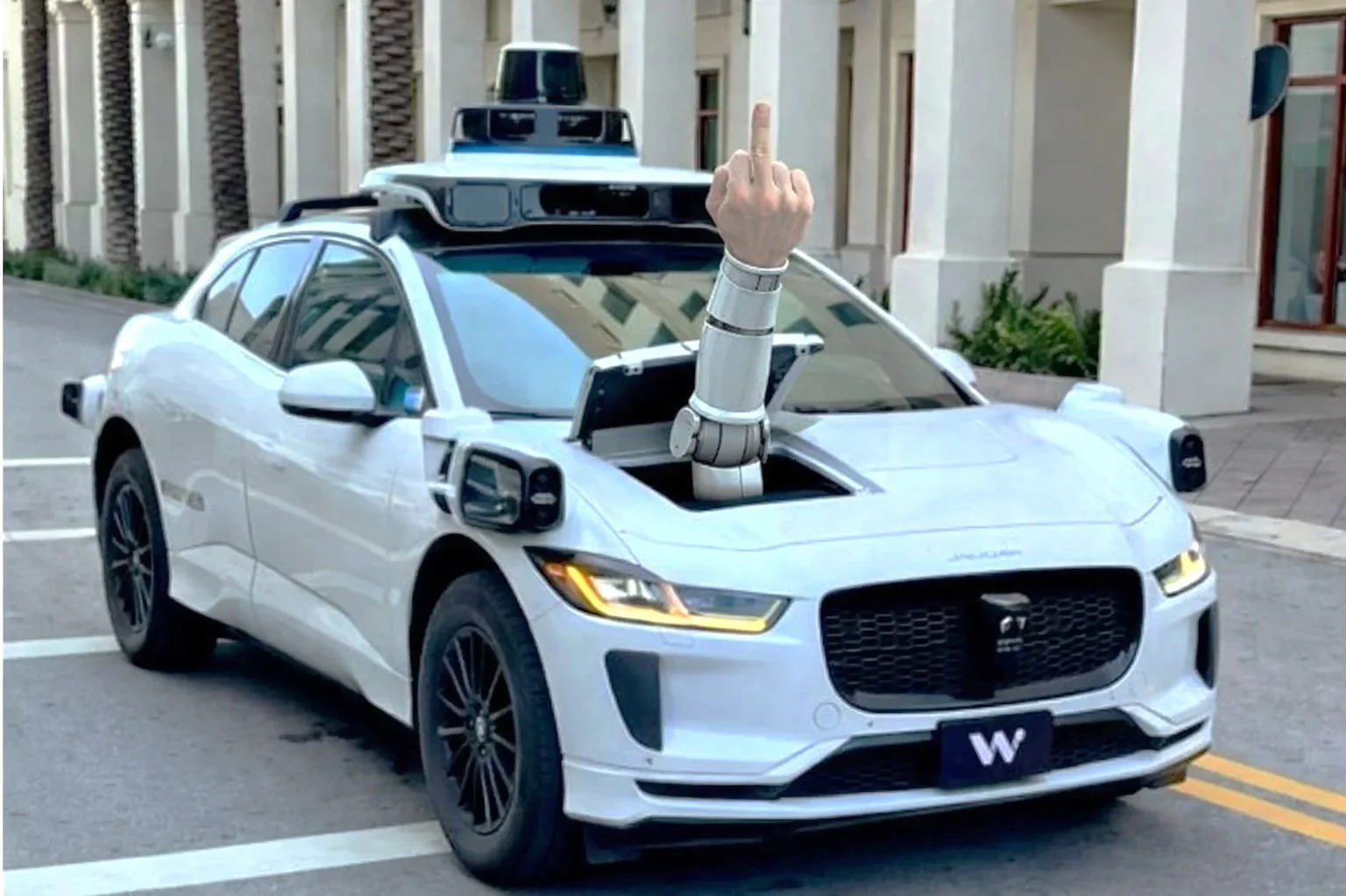
Dave Barry’s “Digital Gesture Of Disapproval Module (DGODM)” concept from his Substack
He writes about the behavioral flaw that lead to the creation of this ingenious product idea:
“My only criticism is that it’s too polite for Miami. At one point, another car cut us off, and the Waymo merely braked to avoid a collision without making any effort to let the other motorist know that he was an idiot. I think this flaw could easily be corrected by modifying the Waymo design to incorporate a robotic Digital Gesture Of Disapproval Module (DGODM) as depicted in this conceptualization”
Did you catch that? The Waymo was “too polite.” The behavior of the other motorists should be recognizable to the AV as being reasonable or unreasonable, and make it so that information can at least be shared with the riders letting them know, “Yeah, I see that idiot.” That way, the rider’s aren’t worried about the AV’s ability to be protective and hold their own against other dangerous drivers.
To be fair, there have been times I’ve taken a taxi or Uber in another country, like Texas, where I couldn’t understand the language of the driver, but I could still understand the driver’s tone and reaction as when one recognizes their life was almost prematurely ended by a 17-year old in a Honda Pilot eating a hotdog. We’ve got to be constantly assessing threats and responding, internally and externally.
Ok, so maybe we don’t need a big, robotic middle finger to let others know we’ve evaluated their poor behavior. But we need some basic, basic methods for real-time behavior assessment, and at the very least, reporting or logging of those behaviors.
If no autonomous vehicle company, to date, has produced a workable definition of appropriately safe behavior, what does that mean for the AV’s ability to accurately assess other’s behaviors? Or their behaviors? It’s not happening.
The draft safety standards are requiring things like “In-Service Monitoring and Reporting (ISMR)” and “trusted, 3rd-party evaluations” but very little practical work has been done to date. Retrospect is here, ready to help industry-leaders in integrating 3rd-party safety evaluations in their AV development and fleet deployments define and demonstrate acceptably safe behaviors in all traffic states.
We owe it all thanks to Dave Barry, and his ingenious analysis and review of what will certainly be his first of many more AV rides to come. Granted, this may have been his one and only ride where he won’t be required to be heavily sedated and distracted with episodes of Gilligan’s Island in order to prevent him from having a robot-dystopian panic attack, but as soon as we get those AV safety metrics to him from trusted 3rd-parties, I’m sure he’ll be more than willing to ride in one fully-conscious. Especially if we have a live video score on the monitor showing the record-low scores of Miami-area drivers around him! Now that would be a genius idea!